

Scoring 'Night Shift': Building a Dystopian World Through Sound Design and Heavy Bass

When establishing the world of a sci-fi thriller, the soundtrack carries a significant amount of the narrative weight. For Night Shift, a near-future dystopian short film, the music needed to function as an organic extension of the environment rather than a detached accompaniment. To achieve this, the sonic identity had to be established well before the project started shooting.
If you haven't already seen the film - you can watch it here:
Early Development: Finding the Sound of Night Shift
Unlike many independent projects where the composer is brought in during post-production, my involvement with Night Shift began during the early script development stage. At that point, the project was envisioned as a feature film, before the proof-of-concept short film even existed. I wrote the titular track, 'NIGHT SHIFT' in 2022, a full two years before the short was actually shot. This collaborative approach - becoming involved during development rather than simply delivering music at the end - is something that informs much of my wider composition work.
Much like the large-scale thematic architecture discussed in my analysis of The Rings of Power, establishing a musical identity early gave the world of Night Shift a sonic framework before the camera even rolled.
We knew this specific piece would accompany the final scene, which was intentionally planned without in-scene dialogue (only voiceover). To anchor the sequence, the director decided to play the track out loud on set during the shoot. This provided the cast and crew with an immediate, unified reference for the tone of the scene, allowing the performances to shape themselves around the music in real time.

The Invisible Ambulance
To ground the film in a gritty, tactile reality, a good chunk of the entire soundtrack relies on manipulated sound design rather than conventional melodic composition. A core thematic element of the film is the constant presence of an emergency vehicle; the ambulance is Rose and Trev's entire world, so a siren needed to be present without becoming overly literal or clashing with the wider sound design.
I spent days finding ways to abstract the sound and feel of the siren into the score. I began by mimicking the movement of a siren with traditional instrumentation, before experimenting with more distorted textures. One breakthrough involved taking a violin bow to a standard metal saw. By bowing the edge and physically bending the metal, it creates a scraping, resonant, and highly unstable tone, that - when 'played' right... - fluctuates in pitch just like an ambulance siren. It evokes the immediate anxiety of an emergency and feels recognisably siren-like while functioning as a structural texture within the music. In many ways, it behaves similarly to a leitmotif, acting as a recurring sonic idea that accumulates meaning throughout the film.
This became a signature sound of the score, appearing across the piece raw, in reverse and scattered across cues. For example, in the pre-title cue, Night 238, you can hear both a real, field recorded British ambulance siren - with lots of effects giving it a distant, dreamlike quality - and the bowed saw, which pops up at the top and tail of the cue.
Sonic Oppression: Urban Weight and Heavy Bass
The opening scene introduces a harsh, aggressively urban near-future dystopia. To perpetuate this oppressive weight throughout the film, the score intentionally incorporates contemporary electronic influences, drawing from EDM and heavy trap production. We brought in thumping basslines, 808 sub-basses with trap drums and hats, to mirror the inescapable gravity of the city, creating a physical sense of pressure that constantly pushes against the protagonists.
This metropolitan environment is heavily emphasised across the score, and to lean into a distinct feeling of urban sleeplessness, one track incorporates textured field recordings captured in a bustling Japanese train station, layered within the mix. Alongside these environmental samples, the cue features distorted, amplified celli that provide an aggressive, industrial grit. Processing these acoustic strings to sound mechanical allowed the music to bridge the gap between traditional instrumentation and modern sound design, externalising the systemic weight of the city.
While much of my work focuses on orchestral and fantasy storytelling, I also enjoy exploring electronic and genre-hybrid projects outside my film work.

Subtext and Restraint: Scoring Dialogue
At the time of composing it, my least favourite cue was one that sat directly beneath a critical dialogue scene inside the ambulance. I worried that introducing music here would clutter the scene or distract from the high-stakes decision-making between the characters, particularly because the film had already established such a music-heavy soundscape.
Michael, the director, insisted on a low, unsettling undercurrent. His perspective was that a subtle musical layer was necessary to highlight the gravity of Rose's choice. On top of this, because the rest of the score maintains such a high-energy, aggressive momentum across the film, removing the music entirely would cause the ambulance sequence to feel sonically isolated from the broader environment.
In retrospect, this approach was entirely correct. The resulting cue has become one of my favourites in the film, providing an atmospheric pressure that almost cries out from within the world to externalise Rose's internal conflict. As I discussed in my comparison of Schindler's List and Inglourious Basterds, music often works most effectively when it operates beneath the surface, shaping audience perception rather than explicitly telling them how to feel.
The Director-Composer Shorthand: A Shared Language
This project marked another chapter in a long-standing creative partnership with Michael, following our previous work on films like Sarcio and Man-Eater. Over the course of these various projects, we have developed a fluid artistic shorthand that relies entirely on a shared creative perspective. This relationship allows us to bypass the usual friction that can occur when aligning visuals with a musical score.

Our process succeeds because we prioritise time spent experimenting early in development. We spend hours bouncing conceptual ideas back and forth, testing boundaries, and building up a shared vocabulary for the project before any rigid structures or edits are locked in. When a director and composer build this level of rapport, the score functions as an organic, irreplaceable pillar of the film itself, deeply woven into the storytelling from the very beginning.
Developing this kind of creative shorthand is central to how I approach collaborations, particularly on projects where music is expected to evolve alongside the story.
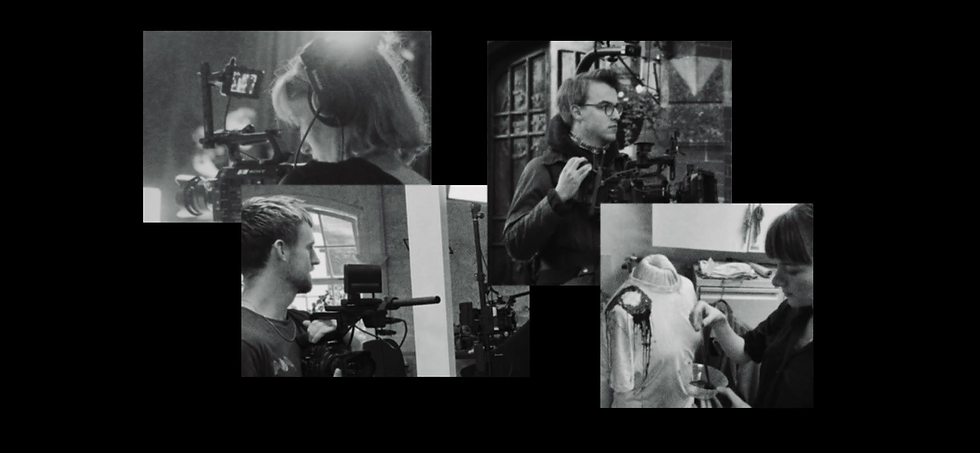
Bringing Night Shift from that initial 2022 demo track to a finished film was a fantastic journey, made possible entirely by a cast and crew who completely understood the grit we were aiming for. Looking back at the project now, it remains a testament to what can happen when the visuals and audio grow together from day one, rather than being treated as completely separate stages of production. Whether discussing other films, or working on my own scores, I keep returning to the same conclusion: music works best when it is treated as part of the storytelling itself. A huge thank you to everyone involved in the shoot, and to everyone who has watched and supported the film since.
If you're developing a film, game, or other narrative project and want to discuss building a sonic identity for it from the earliest stages, I'd love to hear about it.
Night Shift is available to watch online here. The full original soundtrack is available wherever you get your music - Spotify, Apple Music, Amazon Music, and more.

Comments